Integrated Repository of Provider Data
Provider Registry as a Service
Product Overview
Provider Registry as a Service (PRS) is a new product launched in December 2024 that is used internally within Optum’s product suite and provides up-to-date lists of providers, health organizations, locations, specialties, services, and insurance plans. This product has a complex data relationship structure that is tightly regulated to ensure accuracy and compliance. PRS is maintained by internal Optum team members with Market overview to ensure data accuracy. Similar to Order Utility (another Optum Product), the data and even the relationships are unique to each market. For example, most markets have a hierarchical structure of organization > location > practitioner, while others, such as Mountain West, offer only organization-to-location relationships, changing how the data is managed.
Many other complexities factor into this product’s robust capabilities and the ultimate achievement of its success.
New standalone product
Integration with multiple Optum products, feeding updated registry information to their systems for uniformity and compliance
50 Markets and Submarkets with thousands of practitioners, including:
physicians
nurses
hospital staff
physical therapists
at-home care providers
etc.
Relationship mapping between market > submarket > organization > location > practitioner > specialties & services > insurances
User-centered design for content maintenance and control as well as access control groups
Role
Staff Product Designer
Responsibilities
Persona development, IA, Ideation, 0 → 1 UX & maintenance designs
Surfaces
100% desktop
Duration
Multi-year
The Initial Challenge
01
Market & Record Maintenance
Prior to the development of PRS, the business team would download the latest spreadsheet of a market from Order Utility, make any pertinent changes provided by the client, reupload the spreadsheet into Order Utility’s Staging environment, wait 24 hours for the ingestion to complete, validate the data ingested properly, and reach out to the dev team to push the changes to production. It goes without saying that organizing and managing data prior to PRS was a nightmare for the business team. Our goal in creating PRS was to mitigate the painful task of updating a record by allowing users to enter changes directly in a platform that would be immediately updated within Optum’s repository.
Most crucially, the business team needed a way to expedite and simplify record updates. The existing process was frustrating to the business team, the markets, and the end users.
Create a product and process to mitigate user error, bottlenecks, inefficiencies, and the financial drain caused by the existing process.
Create a product that can update one-to-many records without needing to ingest the entire market’s repository.
Create an automated process that applies changes to the frontend of the ingesting products within 24 hours.
Automate spreadsheet data validation by identifying empty cells in columns labeled critical, duplicate rows, address validation, and ID and phone/fax validation.
02
Onboarding New Markets
Onboarding a new market within Optum’s provider registry includes creating records for the organizations, locations, and practitioners, including associated specialties, insurances, etc. that reside within that market’s perview. Each market could have thousands of new records need to be integrated. The markets provide these records in a massive Excel spreadsheet and the business team is responsible for validating the data prior to being uploaded into the database.
The following are just a few challenges the business team posed to the product team during the empathize and define phases.
Analysing completed spreadsheets provided by each market to ensure data is error-free prior to uploading them to OU’s repository is time-consuming, tedious, and prone to user error, given the volume of data and reviewers’ busy schedules.
If content is missing or suspicious, the reviewer takes the time to research and find the correct data via NPEES and online searches. If the data cannot be found or needs clarification or validation from the market, the review must reach out to the market and wait for a response before uploading the entire spreadsheet.
As described in challenge 1, the ingestion process is time-consuming and unnecessarily complex.
Since the data provided by the markets is often not cleaned before they send it to our team, end users often find errors. These include (but are not limited to) duplicate records with conflating information, practitioners, locations, and/or organizations that are no longer part of that market or are no longer practicing, incorrect data such as phone numbers, addresses, and accepted insurances, and missing practitioners, locations and organization that are part of the market but were not included in the spreadsheet.
03
Data Sharing & Integration
Initially Optum’s product Order Utility (OU) housed the provider registry repository. No integration with any other product had been implemented, therefore, each product howsed its own registry and discrepancies were rampent. When PRS was built its sole integration was with OU, however, there were always plans to eventually to integrate other products, allowing them to utilize the same record data that was kept up-to-date by our team.
…
01Solution
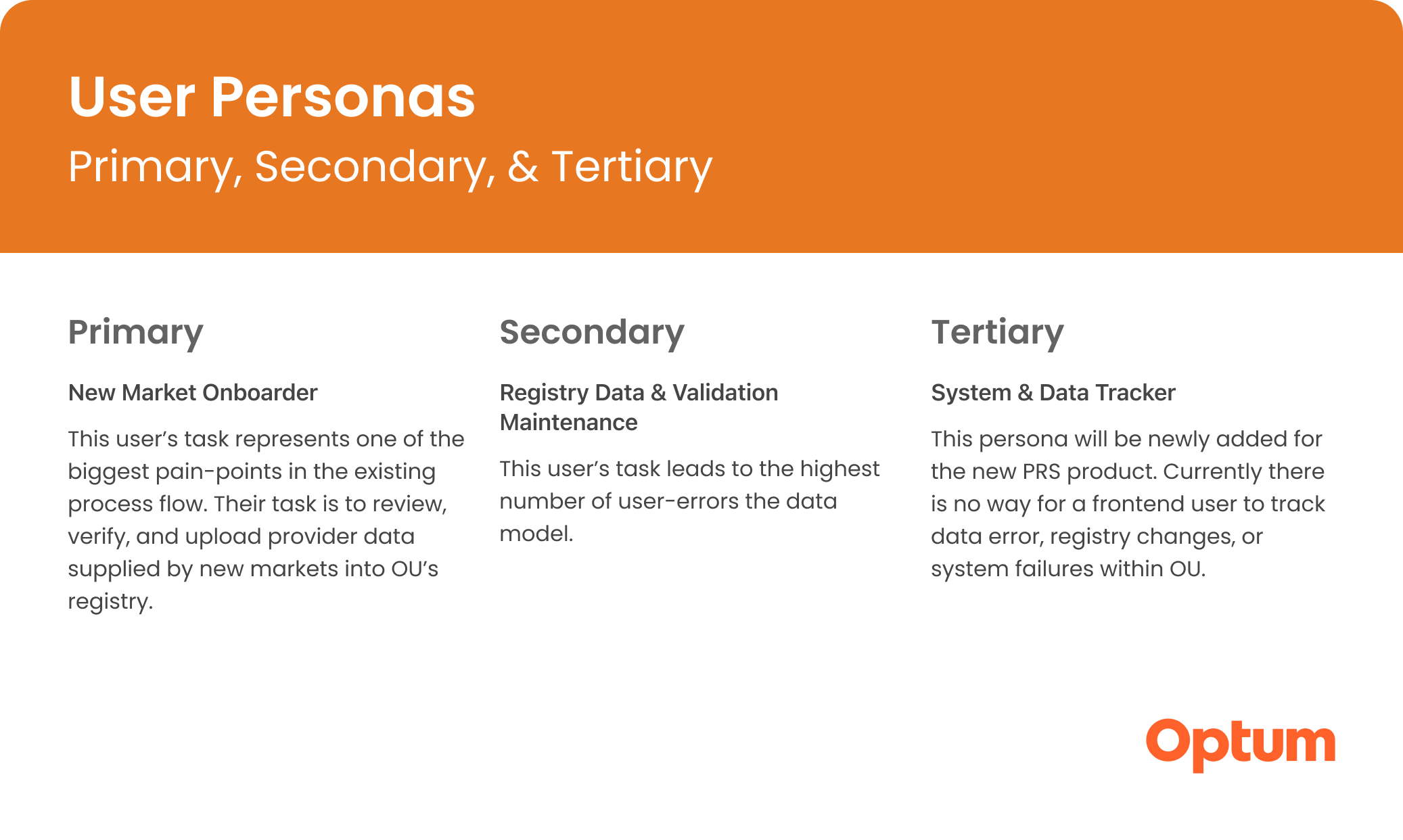
I created 3 user personas. Despite being intended only for a few individuals, PRS had three distinct goals, best defined by three separate persona definitions.
Onboarding new markets
Maintaining registry data and validity
Tracking changes and overseeing data and system health
Results
Our team already understood many of the pain points our users had voiced; however, through this exercise, we uncovered additional opportunities for improvement that we could address through a design and content reorganization overhaul of the product.

Continuous Improvement Post-launch
Since PRS is a new product, there were bound to be growing pains and user requirements that were overlooked during the initial empathize and define stages. During the initial iteration of the product, the business team was so focused on their pain points from the original process that the flow for record updates and additions needed refinement.
01
Onboarding New Markets
As the Optum team onboards new markets such as Mountain West and HCPCA, thousands of new records need to be integrated. The markets provide these records in a massive Excel spreadsheet and the business team is responsible for validating, imputting, and crosschecking the data within PRS.
The following are just a few challenges posed to the product team before, during, and, even, after the products creation.
Manually entering thousands of records was not an option for our business team. The data ingestion needed to be automated.
The format in which the markets provide the record data is a massive Excel spreadsheet that needs to be mapped to our CMS.
Some markets provide data that breaks the initial data model relationships that the team developed.
Requirements for insurance, ID types, specialties vs. subspecialties vs. services, organization naming convention, etc., varied from market to market.
Oftentimes, the markets provide ingestion files with blank columns that are required by our system.
02
Market & Record Maintenance
Since PRS is a new product there were bound to be growing pains and user requirements that were overlooked during the initial empathize and define stages. During the initial itteration of the product, the business team was so focussed on their painpoints from the original process that the data model
Determining the content that is updated the most.
Investigating the typical user flow and how we might improve on it.
Acknowledging the need for multi-record editing capability.
Identifying the data nomenclature that users are familiar with in order to alleviate cognitive load.
Identifying the guardrails needed to prevent users from editing, removing, or inactivating data that is used elsewhere and/or could negatively affect other records.
…
03
Data Sharing & Integration
PRS integrates with multiple products within Optum’s product suite, ensuring that data is up-to-date and consistent across all provider and patient interaction points. Not only does the product feed data to sister products, but it also ingests data records from Optum ProScrub (OPS). In OPS an internal team calls individual hospitals and clinics to verify and update information on a cadence determined by each market. This updated data is then fed back into PRS.
Each ingestion application has a unique data model tailored to its product’s needs and requirements. This makes mapping a challenge for the engineers on both sides.
01Solution
I led the initiative to address PRS user pain points by scheduling recurring team meetings to review completed, on-deck, and new product improvement ideas.
Results
Our team already understood many of the pain points our users had voiced; however, through this exercise, we uncovered additional opportunities for improvement that we could address through a design and content reorganization overhaul of the product.
02Solution
I created, tracked, and co-managed the pain points spreadsheet, which included a list of items, descriptions, notes, alternate options, priority, approval status, design status, and dev status for the team to track.
Results
Our team already understood many of the pain points our users had voiced; however, through this exercise, we uncovered additional opportunities for improvement that we could address through a design and content reorganization overhaul of the product.
03Solution
I developed concept ideas for product improvements based on comments from PRS team meetings, discussions with the business team (direct users), and observations from DataDog (Optum’s analytics tool) session replays.
Results
By watching session replay in DataDog and gleaning frustrations from discussions with the business team, I mapped and concepted three new global solutions:
Global search
Global navigation between tenants from a specific record or section (ex. Insurances, Specialties, Rule Sets, etc.)
Enhancements to the global & tenant dashboards displaying metrics, tasks, and activity